
- A rep is one movement; a set is a group of reps done back to back
- RPE and RIR are simple ways of describing how hard a set felt
- AMRAP, EMOM and 'for time' are common conditioning formats
- If you hear a term you do not know, ask: everyone had to learn it once
The basics: reps, sets and weights
These are the words you will hear in almost every session, whether you train alone or in a class. Once you know them, a workout written on a whiteboard or in an app will make sense at a glance.
- Rep (repetition): one complete movement, such as one squat down and back up.
- Set: a group of reps done without stopping. 3 x 10 means three sets of ten reps.
- Rest: the break between sets, often anything from 60 seconds to three minutes depending on the exercise.
- Working weight: the weight you use for your main sets, after warming up.
- Warm-up or build-up sets: lighter sets done before your working weight.
- 1RM (one-rep max): the most you can lift for a single rep with good form. Beginners do not need to test this.
- PB or PR: personal best or personal record.
- Tempo: the speed of each part of a rep, sometimes written as four numbers, such as 3-1-1-0.
Tempo numbers read as seconds for the lowering phase, the pause at the bottom, the lifting phase and the pause at the top. You will rarely need it as a beginner, but it helps to recognise it when a coach writes it up.
Effort and progress
- RPE (rate of perceived exertion): how hard a set felt, on a scale of 1 to 10.
- RIR (reps in reserve): how many more good reps you could have done. RPE 8 is roughly two reps in reserve.
- Failure: the point where you cannot complete another rep with good form.
- Progressive overload: gradually increasing the challenge over time, the principle behind all progress.
- Deload: a planned lighter week to let your body recover and consolidate.
- Plateau: a spell when progress stalls.
- Volume: the total amount of work, usually counted in sets and reps.
- Intensity: how heavy or hard the work is compared with your maximum.
Our guides to RPE and RIR, progressive overload and deload weeks explain these ideas properly if you want to go further.
Types of exercise and session
Coaches use these words to describe what kind of work you are doing and why. They help you understand how a session fits together.
- Compound exercise: uses several joints and muscle groups at once, such as squats, deadlifts and presses.
- Isolation exercise: targets one joint or muscle, such as a biceps curl.
- Accessory work: supporting exercises done after the main lift.
- Superset: two exercises done back to back with little rest between them.
- Circuit: several exercises done one after another in sequence.
- Conditioning or metcon: training aimed at your heart, lungs and endurance.
- Finisher: a short, hard piece at the end of a session.
- Hybrid training: combining strength and endurance training in one programme.
- Unilateral: working one side at a time, such as a lunge or single-arm row.
- Mobility: exercises that improve how freely you move through a range of motion.
Conditioning formats
- AMRAP: as many rounds or reps as possible in a set time.
- EMOM: every minute on the minute. Do the work at the start of each minute and rest for whatever is left.
- For time: complete a set amount of work as fast as you can with good form.
- Intervals: alternating periods of work and rest.
- Tabata: a specific interval format of 20 seconds hard and 10 seconds rest, eight times through.
- Steady state: a continuous effort at a consistent, usually moderate pace.
- Zone 2: an easy, conversational intensity often used for building aerobic fitness.
If you want to know how these formats are used in practice, see our guide to conditioning classes explained.
Equipment and the gym floor
- Barbell: the long bar used for squats, deadlifts and presses. A standard one weighs 20 kg.
- Plates: the discs loaded onto a barbell. Bumper plates are rubber and can be dropped where the gym allows.
- Collars: clips that hold plates in place on the bar.
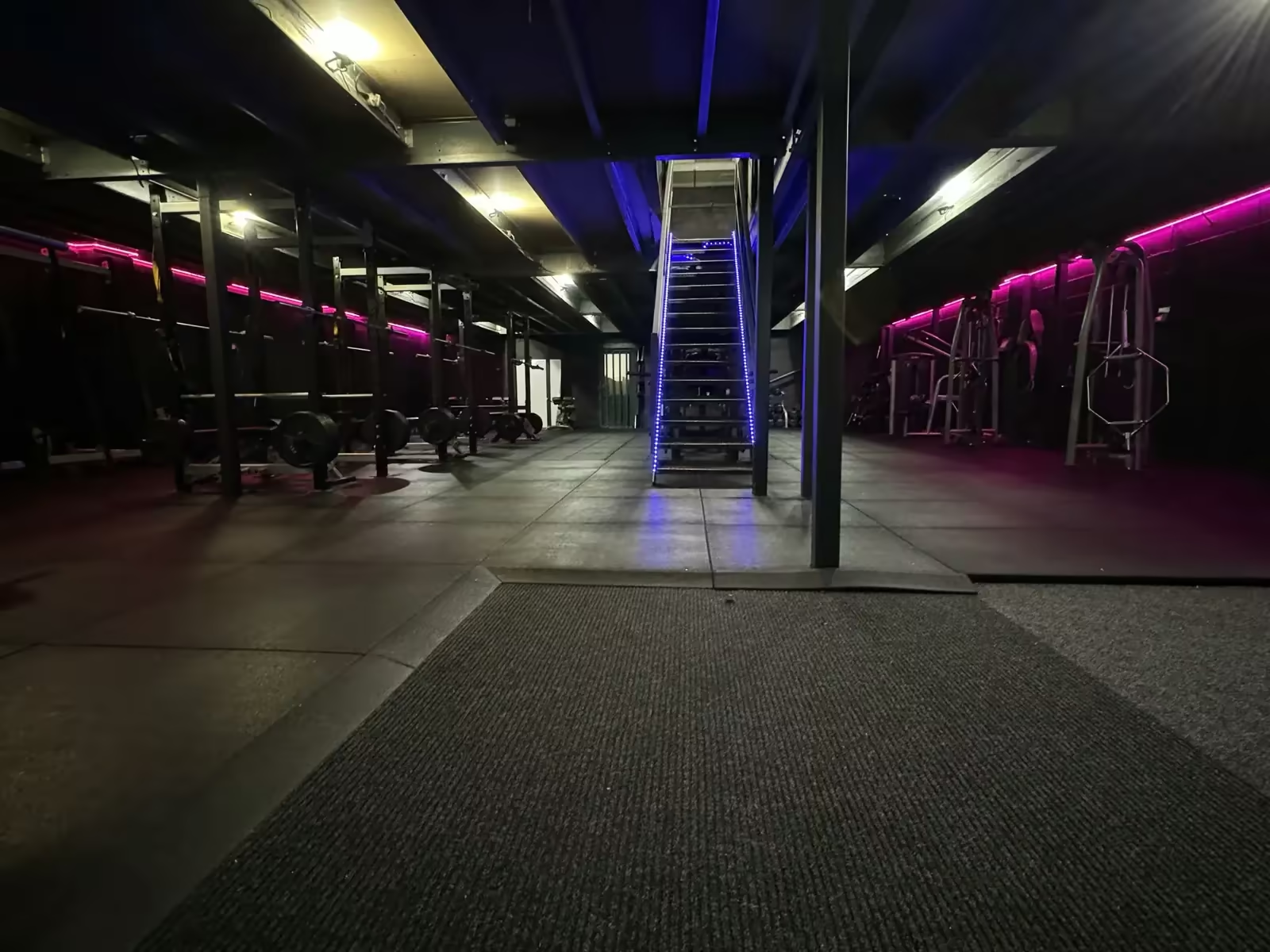
- Rack or squat rack: a frame with hooks to hold the bar at chest height, plus safety arms.
- Rig: a larger steel frame combining several racks, pull-up bars and attachments.
- Safety arms or spotter arms: bars that catch the barbell if you fail a rep.
- Spotter: a person who helps you if you cannot finish a rep.
- Working in: sharing equipment by alternating sets with someone.
- KB and DB: kettlebell and dumbbell.
- Sled: a weighted sled pushed or pulled along turf or a track.
- SkiErg, rower and air bike: the main conditioning machines in many hybrid gyms.
For the unwritten rules around sharing all this kit, see our gym etiquette guide.
HYROX and recovery terms
If you train at a hybrid or HYROX gym, you will hear a few race-specific words too, along with some recovery terms that apply to everyone.
- HYROX: a fitness race of 8 x 1 km runs, each followed by a functional station.
- Stations: the eight exercises in HYROX, such as the sled push, wall balls and farmers carry.
- Roxzone: the transition area between the running and the stations. See our guide to the Roxzone.
- Divisions: HYROX categories, including Open, Pro, Doubles and Relay.
- DOMS: delayed onset muscle soreness, the stiffness you feel a day or two after new exercise.
- Active recovery: light movement on rest days that helps you feel less stiff.
- Scaling: adjusting an exercise to suit your current level.
Still hearing words you do not recognise? Ask. Coaches use this language every day and forget it is not obvious. Every class at Lycan Strength is scalable, with coaches adjusting movements to the person, so asking what something means is also the quickest way to get the right version for you.
Members' guide
Keep reading with your free week
The full guide is for members and people on a free trial. Claim 7 days free and it opens straight away on this device, along with every other guide.
Already a member? Log in to read it
Unlock the full guide
Seven days of classes, free. We will be in touch to book your first session.
Questions
What does 3 x 10 mean in the gym?
Three sets of ten reps. Do ten repetitions, rest, and repeat until you have completed three sets.
What is the difference between AMRAP and EMOM?
An AMRAP asks you to do as much work as possible in a set time. An EMOM gives you a set amount of work at the start of each minute, and you rest for whatever time is left.
What does RPE 8 mean?
It means the set felt like an 8 out of 10 for effort, with roughly two good reps left in reserve.
What is a PB?
A personal best: the most weight, the most reps or the fastest time you have ever achieved on a particular exercise or workout.
General guidance for healthy adults. If you have a medical condition, injury or are pregnant, check with a health professional before changing your training or diet.