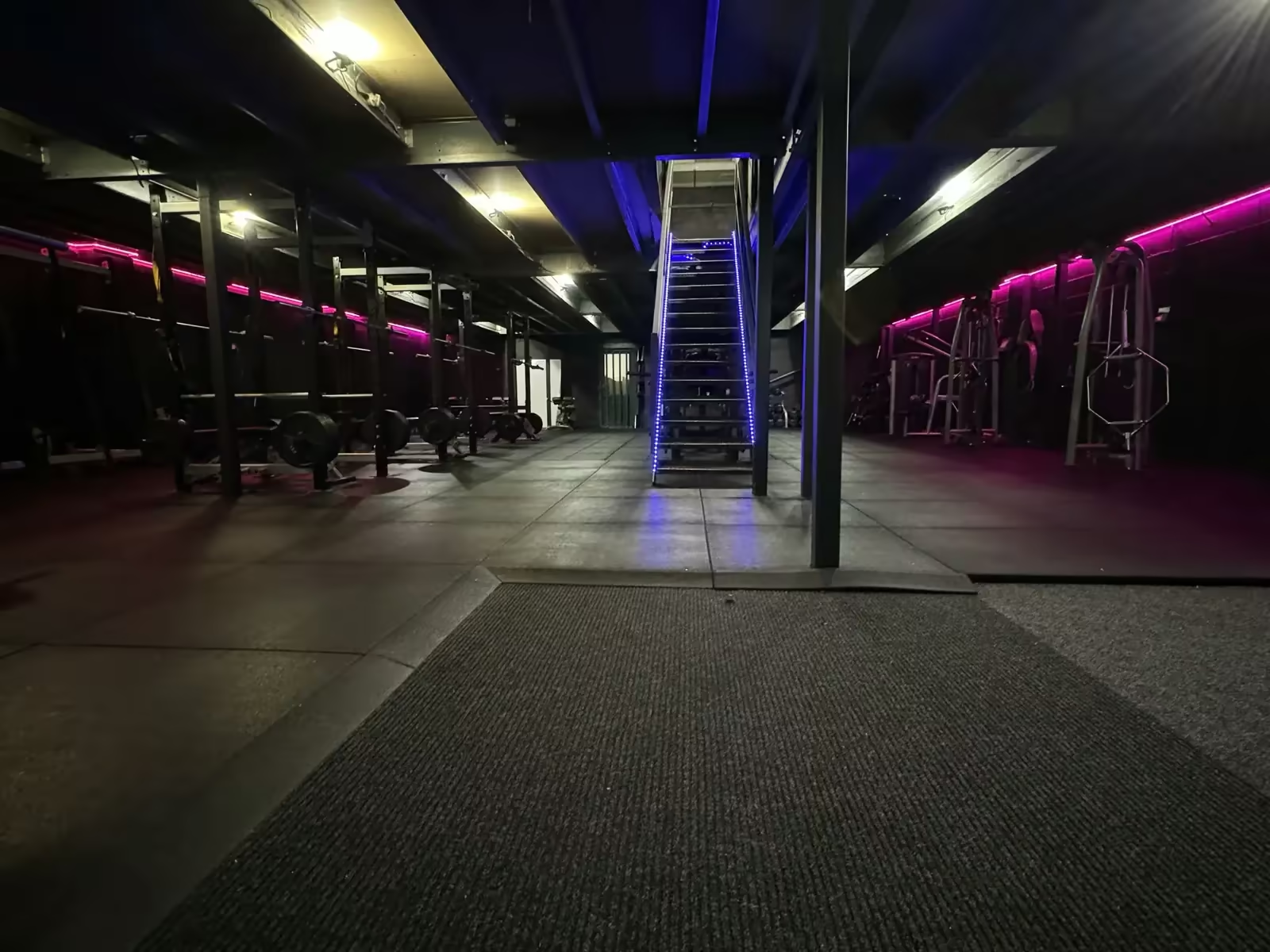

- Heavy strength training can improve running economy without adding bulk.
- Calves, single leg strength and the posterior chain deserve priority.
- Two sessions a week in base training and one in race phase is a practical target.
- Lift on hard run days or after easy runs, not before key sessions.
Why runners should lift
Running is repetitive loading. Each stride puts several times your body weight through your legs, thousands of times per run. Stronger muscles and tendons handle that load with more margin, which is one reason strength training is widely recommended for reducing overuse injury risk in runners, alongside sensible increases in mileage.
Performance improves too. Research consistently shows that adding strength training, particularly heavy lifting and plyometrics, can improve running economy, meaning you use less energy at a given pace. Better economy translates into faster times without extra running, and stronger legs hold their form better late in a race.
Many runners worry about gaining weight or getting bulky. With two short sessions a week alongside a running programme and normal eating, significant muscle gain is very unlikely. What changes is how strong and springy the muscle you already have becomes.
What to train
- Calves and Achilles: the calf complex does a huge amount of work in running. Heavy calf raises, with both a straight and a bent knee, are among the most valuable exercises a runner can do.
- Single leg strength: running is a series of single leg bounds. Split squats, step-ups, lunges and single leg Romanian deadlifts build strength and control on one leg.
- Posterior chain: glutes and hamstrings drive you forward and help protect against hamstring strains. Hip thrusts, Romanian deadlifts and Nordic curls are staples.
- Heavy compound lifts: squats, deadlifts or trap bar deadlifts with heavy loads and low reps improve maximal strength and economy.
- Plyometrics: pogo hops, skipping and bounding develop the springy stiffness that helps economy. See plyometrics explained.
- Trunk: side planks, dead bugs and carries help you hold your posture late in runs.
You do not need every item in every session. Two main lower body exercises, some calf work and a few minutes of hops cover the essentials.
Lift heavy, not just high reps
Many runners default to light weights for lots of reps, reasoning that running is an endurance sport. But you already get plenty of endurance work from running. What the gym can add is force: the ability to push harder into the ground on each stride. That comes from heavier loads for fewer reps.
For main lifts, sets of 3 to 6 reps at a challenging weight, stopping two or three reps short of failure, work well. Accessories and calf work can sit in the 6 to 12 range. If you are new to lifting, build up from lighter weights over a few weeks first.
Heavy lifting also teaches your nervous system to recruit muscle quickly, which is part of why it helps running economy even without much change in muscle size.
How to fit it around your running
Timing matters more for runners than for most lifters, because your legs need to be fresh for key sessions:
- Hard days hard, easy days easy: lift on the same day as a hard run, ideally a few hours later, so your easy days stay easy.
- Protect key sessions: avoid heavy leg work the day before intervals, tempo runs or long runs.
- After easy runs is fine: a short strength session after an easy run is a common, effective pattern.
- Base phase: two strength sessions a week.
- Race phase: one session a week, with lower volume but still some heavy work, to maintain.
- Race week: a short, light session early in the week, or none at all.
A sample session: 5 minutes of skipping and pogo hops, trap bar deadlift 3 x 5, Bulgarian split squat 3 x 6 each leg, single leg calf raise 3 x 10 each leg, Nordic curls 2 x 5, side plank 2 x 30 seconds each side. That takes around 40 to 45 minutes.
Starting out
If you have never lifted, begin with bodyweight and light dumbbell versions of the same exercises for three or four weeks. Do not start a new strength programme in the final weeks before a goal race; the best time is the start of a base phase, when running intensity is lower.
Soreness after the first few sessions can affect your runs for a day or two, and it settles within a couple of weeks. Keep sessions short and consistent rather than long and brutal. If you have a history of running injuries, it is worth having a coach or physio check your single leg control and technique early on.
Common mistakes
- Lifting only light weights for high reps and wondering why nothing changes.
- Doing heavy leg sessions the day before interval sessions.
- Stopping strength work completely once race season starts.
- Ignoring calves and feet while doing plenty of upper body work.
- Adding strength training and extra mileage at the same time.
Change one thing at a time, and treat strength training as part of your running programme rather than an extra. Runners who stick with it for a full season often wonder why they left it so long.
After injury, and for HYROX
If you are coming back from a running injury, a structured strength and loading plan is usually central to the return. Our guide to returning to running after injury outlines what that involves, and Lycan Strength's on-site physiotherapy can build a plan with you, with 20% off for members.
HYROX athletes are runners too, with eight kilometres of running between stations. Strength work builds legs that can cope with sled pushes and lunges and then run again. Our guide to running training for HYROX covers the running side.
Members' guide
Keep reading with your free week
The full guide is for members and people on a free trial. Claim 7 days free and it opens straight away on this device, along with every other guide.
Already a member? Log in to read it
Unlock the full guide
Seven days of classes, free. We will be in touch to book your first session.
Questions
Will strength training make me a slower runner?
No. Sensible strength training tends to improve running economy and resilience, and large gains in muscle mass are unlikely alongside a running programme.
How many times a week should runners lift?
Two sessions a week during base training and one during race phase is a practical target for most runners.
Should runners lift heavy or light?
Mostly heavy for main lifts, with sets of 3 to 6 reps. Running already provides the endurance; strength training adds force.
When should I lift relative to my runs?
On the same day as hard runs, ideally a few hours later, or after easy runs. Avoid heavy leg work the day before key sessions.
General guidance for healthy adults. If you have a medical condition, injury or are pregnant, check with a health professional before changing your training or diet.